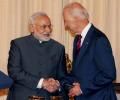
Biden and Modi committed that the US and India will work closely together to win the fight against the COVID-19 pandemic, renew their partnership on climate change, rebuild the global economy in a way that benefits the people of both countries, and stand together against the scourge of global terrorism, the White House said in a readout of the call.

Biden met with Prime Minister Kishida Fumio of Japan on Monday to advance cooperation on a range of bilateral, regional, and global issues.

US President Joe Biden on Saturday rolled out the red carpet to welcome leaders of Quad countries, Prime Ministers Narendra Modi of India, Anthony Albanese from Australia and Fumio Kishida of Japan.

The India-United States relationship is set to expand under the Donald Trump administration, but there could be some unease on issues like imports, tariffs and immigration, strategic affairs experts said after the Republican leader won the fiercely contested presidential election.
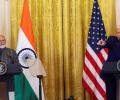
United States President Donald Trump on Thursday announced the extradition of the 26/11 Mumbai terror attack accused Tahawwur Rana to India and said he will face justice.

Defence Minister Rajnath Singh arrives to visit the United States Indo-Pacific Command headquarters and the Pacific Fleet in Hawaii.

The annual Quad summit at President Joe Biden's hometown Wilmington is expected to roll out a series of new initiatives to boost cooperation in the Indo-Pacific and explore ways to find peaceful solutions to the conflicts in Ukraine and Gaza.
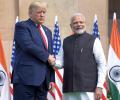
Prime Minister Narendra Modi and US President Joe Biden will have a substantive engagement on the sidelines of the Quad summit on Saturday, and the two sides will sign at least two agreements following the talks.

The Bloomberg report suggests that this backchannel communication from President Xi has laid the groundwork for a broader thaw in relations. This overture has since translated into a series of tangible diplomatic actions leading up to the upcoming Shanghai Cooperation Organisation (SCO) summit.

The US is making investments in defence ties with India to uphold a favourable balance of power in the Indo-Pacific, a top Pentagon official told lawmakers Thursday indicating that strengthening ties with New Delhi is one of the key factors to address the pacing challenge from China.
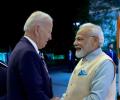
The White House readout of the call had no reference to Bangladesh, which was mentioned in an 'X' post by PM Modi.
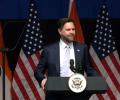
US Vice President JD Vance called on India to drop non-tariff barriers, give greater access to its markets and buy more American energy products and military hardware. Vance, in a speech in Jaipur, highlighted the need for a stronger US-India partnership for a prosperous and peaceful 21st century. He emphasized the importance of working together to address global challenges and praised Prime Minister Narendra Modi, describing him as a "special person." Vance also urged India to provide greater market access to American products and buy more defense platforms and energy from the US. He suggested that India consider dropping some of the non-tariff barriers for American access to the Indian market and highlighted the benefits of closer India-US defense collaboration, advocating for New Delhi to procure more military hardware from the US. He cited the example of American fifth-generation F-35s, arguing they would give the Indian Air Force the ability to defend its airspace and protect its people like never before. Vance also welcomed the Modi government's budget announcement to amend India's civil nuclear liability laws, paving the way for US producers to export small modular reactors and build larger US-designed reactors in India. He emphasized the importance of energy security for India's AI ambitions, stating "there is no AI future without energy security and energy dominance." Vance's visit comes amid growing global concerns over the US's tariff war.

India, Australia, Japan and the US on Friday pledged to work together for ensuring peace and prosperity of the Indo-Pacific and the world, as top leaders of the Quad grouping announced a slew of new initiatives to take on common challenges, amidst muscle flexing by an assertive China in the strategic region.
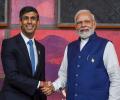
British Prime Minister Rishi Sunak on Wednesday green lit a new youth mobility partnership scheme that will offer 3,000 visas to 18-30-year-old degree-educated Indians every year to live and work in the United Kingdom for up to two years.

Prime Minister Modi on Saturday left for Egypt after concluding his state visit during which he held wide-ranging talks with President Joe Biden and addressed the joint session of the US Congress.

'The President-elect firmly believes we can avoid conflict with the Chinese Communist party because they need our markets.'
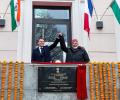
Prime Minister Narendra Modi and French President Emmanuel Macron have called for enhancing trade and investment ties between their countries and committed to further deepening their engagement in the Indo-Pacific. They discussed a full spectrum of bilateral relations, including key global and regional issues, and stressed the urgent need for reform in the United Nations Security Council. The leaders also underscored their commitment to ensuring the global AI sector can drive positive social, economic, and environmental outcomes.

Prime Minister Narendra Modi along with his counterparts from Australia and Japan on Friday attended the first in-person meeting of Quad leaders hosted by US President Joe Biden during which they plan to discuss issues like climate change, Covid-19 pandemic and challenges in the Indo Pacific, amidst China's growing military presence in the strategic region.
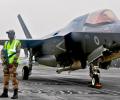
While the peacetime stranding of a foreign fighter jet is rare in India, the F-35 -- a military asset of a foreign country with which India has strategic relations -- was being guarded by the Central Industrial Security Force, the agency responsible for security at Indian airports.

In his opening remarks at a ministerial meeting in Tokyo of the Quadrilateral coalition, also known as 'Quad', External Affairs Minister S Jaishankar said India remained committed to a rules-based world order, respect for territorial integrity and sovereignty, and peaceful resolution of disputes.

The India-Japan global partnership is based on shared democratic values and respect for the rule of law and promotes peace and stability in the Indo-Pacific, Prime Minister Narendra Modi said on Monday after holding wide-ranging talks with his Japanese counterpart Fumio Kishida.
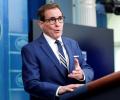
National Security Council Coordinator for Strategic Communications (NSCCSC) John Kirby on Tuesday told a press conference in Washington, DC: "India will be a critical strategic partner for the United States in the coming decades."
Russia needs to be held accountable for the tragic loss of lives in Ukraine following its 'terrible' invasion of that country, Australian Prime Minister Scott Morrison said on Monday at a virtual summit with his Indian counterpart Narendra Modi.
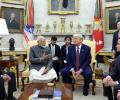
India and the United States have agreed to deepen their strategic partnership in several key areas, with President Donald Trump announcing plans to provide India with F-35 fighter jets and billions of dollars in military supplies. The two leaders also discussed energy cooperation, critical technologies, connectivity, and countering terrorism. They agreed to work together on the India-Middle East-Europe Economic Corridor, and Trump noted India's reforms to welcome US nuclear technologies. Prime Minister Modi said the two countries can shape a better world through their cooperation. Both leaders also addressed the Russia-Ukraine conflict, with Modi stressing India's commitment to peace.
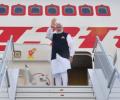
New initiatives to boost cooperation to ensure stability in the Indo-Pacific, ways to find peaceful solutions to the conflicts in Ukraine and Gaza and addressing concerns of the global South will be the focus of Prime Minister Narendra Modi's three-day visit to the US beginning Saturday.
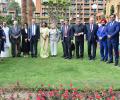
All-party parliamentary delegations on Monday met with the leaders of several countries and highlighted India's resolve to combat terrorism, which they stressed must be eradicated in the interests of all humanity.

US Secretary of State Marco Rubio claims President Donald Trump was instrumental in bringing about the cessation of hostilities between India and Pakistan, a claim India has consistently denied.

The Pahalgam massacre highlights the evolution of terrorism into a multi-domain challenge. India's response must similarly evolve -- from tactical retaliation to comprehensive strategic deterrence. To establish a credible and sustained deterrent, India must also carry out continuous kinetic operations, both overt and covert, suggest Sakshit Raina and Rahul Mishra. To establish a credible and sustained deterrent, India must also carry out continuous kinetic operations, both overt and covert, suggest Sakshit Raina & Rahul Mishra.
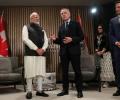
India and Canada have agreed to restore High Commissioners to each other's capitals at an early date, the first in 'calibrated steps' to restore stability to the 'very important relationship', Foreign Secretary Vikram Misri said.

'Pakistan is an ally who gives the US access.' 'If we have a presence there, it puts us that much closer to China and puts our assets closer to China and Iran.'

The meeting between Jaishankar and Pompeo comes at a time both India and the US are at loggerheads with China.
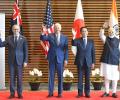
Biden welcomed Prime Minister Modi at the Summit and said "it is wonderful to see you again in person".
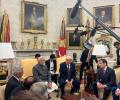
'Trump is not shy when he is frustrated with countries'

"President Biden has had warm and productive early conversations with his counterparts in Australia, India, and Japan, and looks forward to engaging even more directly with our partners in the Indo-Pacific as soon as possible," a senior administration official told PTI.
The remarks by the Chinese foreign ministry came a day after Secretary of State Mike Pompeo assured India that the US stands firmly with it to confront threats to its sovereignty.

Navy chief Admiral R Hari Kumar on Monday flagged concerns over growing geo-political power play in the Indo-Pacific, and noted that the US-China rivalry in the region is likely to be a "marathon".

Australian Deputy PM Marles to watch India-Australia World Cup cricket final in Ahmedabad

Prime Minister Narendra Modi on Thursday said India and Italy have decided to elevate their bilateral ties to a strategic partnership, opening a new chapter on defence cooperation.

The French Air and Space Force is carrying out a major long-range mission in the Indo-Pacific, code-named Pegase 22, from August 10 to September 18.

'The policies announced by his administration are implemented faster.'
